 Add to Chrome
 Add to Firefox
 Add to Edge
AgentSchool: An LLM-Powered Multi-Agent Simulation for Education
May 28, 2026
Despite the rapid deployment of LLMs into classrooms, validating educational AI remains uniquely intractable: interventions act on developing learners whose cognitive and social trajectories are irreversibly shaped, while real-world trials are slow, ethically constrained, and institutionally locked. LLM-based educational simulators have emerged as a potential remedy, but many still collapse learning into persona-conditioned role-play and, when optimized only to reproduce existing classrooms, can structurally penalize the institutional novelty that pedagogical reform requires. In this work, we introduce AgentSchool, an LLM-driven multi-agent simulator that models learning as state transition rather than prompted behavior. AgentSchool couples cognitively growable student agents -- equipped with weighted subject knowledge graphs, thinking-workflow pools, and explicit misconceptions -- with adaptive teacher agents that plan, scaffold, and reflect along the Zone of Proximal Development, embedded in a configurable scenery generator that situates instruction within both formal and informal learning fields, and a multi-scale simulator that decouples interaction scale, temporal granularity, and simulation duration. Experiments show that structured student agents produce more differentiated mastery and misconception traces than a baseline simulator, while teacher-agent comparisons show backbone-dependent patterns consistent with ZPD-informed adaptation. Further, AgentSchool generates plausible traces of peripheral participation, clique formation, aggressor-induced cohesion, and opinion-leader emergence consistent with classroom social theories. Beyond its role as an educational research instrument, AgentSchool frames education as a socially meaningful testbed for long-horizon memory, multi-agent coordination, and future institutional reasoning under organizational pressure.

OptSkills: Learning Generalizable Optimization Skills from Problem Archetypes via Cluster-Based Distillation
May 28, 2026Leveraging Large Language Models (LLMs) to automatically formulate and solve optimization problems from natural language has emerged as an efficient paradigm for automated optimization. However, existing methods still exhibit limited generalization: they are sensitive to superficial narrative variations, reuse experience mainly at the case level, and struggle to adapt to shifted or emerging problem types. We propose OptSkills, an archetype-centric skill learning and reasoning agent system for optimization modeling and solving. To improve robust generalization, our system clusters problems by their underlying archetypes rather than surface narratives. To improve in-distribution generalization, it explores diverse modeling paradigms and solver configurations within each cluster, then distills successful trajectories into reusable workflow-level skills. To improve out-of-distribution generalization, it refines existing skills or expands the skill library using newly obtained trajectories. Our system achieves a state-of-the-art micro-averaged accuracy of 68.27% on datasets encompassing diverse problem types and scenarios. In addition, on MIPLIB-NL, a highly challenging large-scale and high-dimensional benchmark, it achieves 26.91% accuracy, outperforming DeepSeek-V3.2-Thinking by 4.53%. After skill learning on Nano-CO, it reaches 72.79% on the OOD NLCO benchmark. Code and skills are available at https://github.com/fujiwaranoM0kou/OptSkills.
Automated Random Embedding for Practical Bayesian Optimization with Unknown Effective Dimension
May 25, 2026Bayesian optimization is widely employed for optimizing complex black-box functions but struggles with the curse of dimensionality. Random embedding, as a dimension reduction strategy, simplifies tasks that possess the effective dimension by optimizing within a low-dimensional subspace. However, determining the effective dimension of a task in advance remains a significant challenge, which influences the selection of the subspace dimensionality and the optimization performance. Traditional methods use fixed subspace dimensions provided by experts or rely on trial and error to estimate subspace dimensions with resources consumed. To this end, this paper proposes an automated random embedding for high-dimensional Bayesian optimization with unknown effective dimension, called Dynamic Shared Embedding Bayesian Optimization (DSEBO). DSEBO starts with a low dimension and switches to a higher subspace if the solutions in the current subspace show preliminary convergence. DSEBO dynamically determines the dimension of the next subspace based on the quality of the solutions in different subspaces and shares the queried solutions with the new subspace for a better initialization. Theoretically, we derive a regret bound for DSEBO and demonstrate that DSEBO can better balance approximation and optimization errors. Extensive experiments on functions with dimensionality of varying magnitudes and real-world tasks with unknown effective dimensions reveal that, compared with state-of-the-art methods, alternating optimization across different subspaces results in significant improvements in high-dimensional optimization, both in terms of optimization regret and time.
AlphaContext: An Evolutionary Tree-based Psychometric Context Generator for Creativity Assessment
Apr 21, 2026Creativity has become a core competence in the era of LLMs and human-AI collaboration, underpinning innovation in real-world problem solving. Crucially, the systematic improvement of creativity necessitates scientifically valid assessment instruments. Psychometric research recognizes context-based assessment as an effective way to measure creative thinking. However, high-quality expert-designed contexts remain scarce. Existing LLM-based generators often struggle with insufficient assessment cues, weak narrative coherence, limited stylistic diversity, and poor support for creative thinking. To address these challenges, we propose AlphaContext, an evolutionary tree-based psychometric context generator for creativity assessment. First, the HyperTree Outline Planner formalizes expert-designed outlining as a rule-guided hypertree and performs top-down hierarchical planning. The MCTS-based Context Generator fills the outline via MCTS to balance global structure and local quality. Then, the Evolutionary Context Optimizer evolves contexts with MAP-Elites by repeatedly updating niche elites to jointly improve diversity and quality. Finally, the Assessment-Guided Evolution Refiner simulates virtual participants with diverse styles and recycles weak contexts for further evolution. Experiments show that AlphaContext yields an average improvement of 8% over competitive methods across 6 quality metrics.
Embedding Enhancement via Fine-Tuned Language Models for Learner-Item Cognitive Modeling
Apr 05, 2026Learner-item cognitive modeling plays a central role in the web-based online intelligent education system by enabling cognitive diagnosis (CD) across diverse online educational scenarios. Although ID embedding remains the mainstream approach in cognitive modeling due to its effectiveness and flexibility, recent advances in language models (LMs) have introduced new possibilities for incorporating rich semantic representations to enhance CD performance. This highlights the need for a comprehensive analysis of how LMs enhance embeddings through semantic integration across mainstream CD tasks. This paper identifies two key challenges in fully leveraging LMs in existing work: Misalignment between the training objectives of LMs and CD models creates a distribution gap in feature spaces; A unified framework is essential for integrating textual embeddings across varied CD tasks while preserving the strengths of existing cognitive modeling paradigms to ensure the robustness of embedding enhancement. To address these challenges, this paper introduces EduEmbed, a unified embedding enhancement framework that leverages fine-tuned LMs to enrich learner-item cognitive modeling across diverse CD tasks. EduEmbed operates in two stages. In the first stage, we fine-tune LMs based on role-specific representations and an interaction diagnoser to bridge the semantic gap of CD models. In the second stage, we employ a textual adapter to extract task-relevant semantics and integrate them with existing modeling paradigms to improve generalization. We evaluate the proposed framework on four CD tasks and computerized adaptive testing (CAT) task, achieving robust performance. Further analysis reveals the impact of semantic information across diverse tasks, offering key insights for future research on the application of LMs in CD for online intelligent education systems.
Surrogate-Assisted Evolutionary Reinforcement Learning Based on Autoencoder and Hyperbolic Neural Network
May 26, 2025Evolutionary Reinforcement Learning (ERL), training the Reinforcement Learning (RL) policies with Evolutionary Algorithms (EAs), have demonstrated enhanced exploration capabilities and greater robustness than using traditional policy gradient. However, ERL suffers from the high computational costs and low search efficiency, as EAs require evaluating numerous candidate policies with expensive simulations, many of which are ineffective and do not contribute meaningfully to the training. One intuitive way to reduce the ineffective evaluations is to adopt the surrogates. Unfortunately, existing ERL policies are often modeled as deep neural networks (DNNs) and thus naturally represented as high-dimensional vectors containing millions of weights, which makes the building of effective surrogates for ERL policies extremely challenging. This paper proposes a novel surrogate-assisted ERL that integrates Autoencoders (AE) and Hyperbolic Neural Networks (HNN). Specifically, AE compresses high-dimensional policies into low-dimensional representations while extracting key features as the inputs for the surrogate. HNN, functioning as a classification-based surrogate model, can learn complex nonlinear relationships from sampled data and enable more accurate pre-selection of the sampled policies without real evaluations. The experiments on 10 Atari and 4 Mujoco games have verified that the proposed method outperforms previous approaches significantly. The search trajectories guided by AE and HNN are also visually demonstrated to be more effective, in terms of both exploration and convergence. This paper not only presents the first learnable policy embedding and surrogate-modeling modules for high-dimensional ERL policies, but also empirically reveals when and why they can be successful.
A Dual-Fusion Cognitive Diagnosis Framework for Open Student Learning Environments
Oct 19, 2024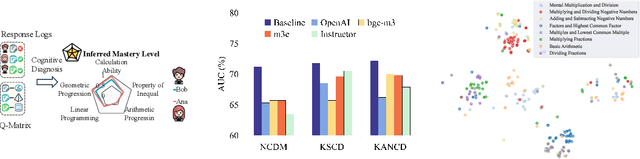

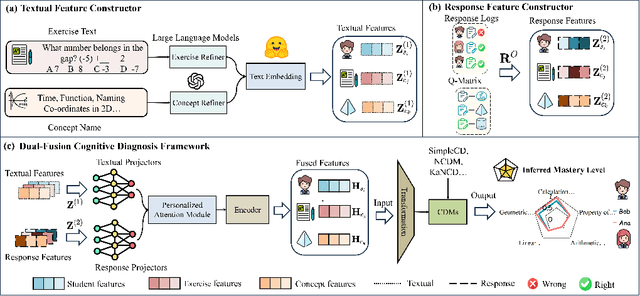
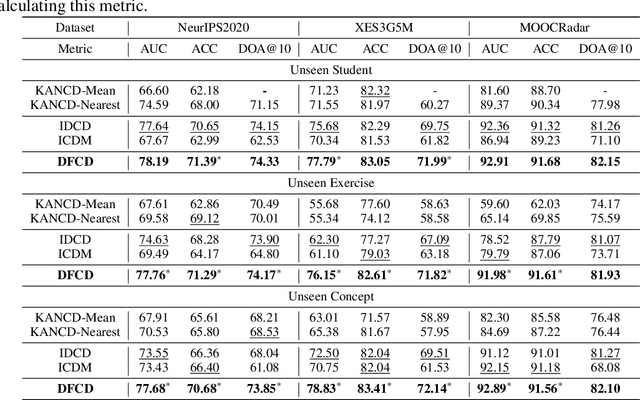
Cognitive diagnosis model (CDM) is a fundamental and upstream component in intelligent education. It aims to infer students' mastery levels based on historical response logs. However, existing CDMs usually follow the ID-based embedding paradigm, which could often diminish the effectiveness of CDMs in open student learning environments. This is mainly because they can hardly directly infer new students' mastery levels or utilize new exercises or knowledge without retraining. Textual semantic information, due to its unified feature space and easy accessibility, can help alleviate this issue. Unfortunately, directly incorporating semantic information may not benefit CDMs, since it does not capture response-relevant features and thus discards the individual characteristics of each student. To this end, this paper proposes a dual-fusion cognitive diagnosis framework (DFCD) to address the challenge of aligning two different modalities, i.e., textual semantic features and response-relevant features. Specifically, in DFCD, we first propose the exercise-refiner and concept-refiner to make the exercises and knowledge concepts more coherent and reasonable via large language models. Then, DFCD encodes the refined features using text embedding models to obtain the semantic information. For response-related features, we propose a novel response matrix to fully incorporate the information within the response logs. Finally, DFCD designs a dual-fusion module to merge the two modal features. The ultimate representations possess the capability of inference in open student learning environments and can be also plugged in existing CDMs. Extensive experiments across real-world datasets show that DFCD achieves superior performance by integrating different modalities and strong adaptability in open student learning environments.
LLMOPT: Learning to Define and Solve General Optimization Problems from Scratch
Oct 17, 2024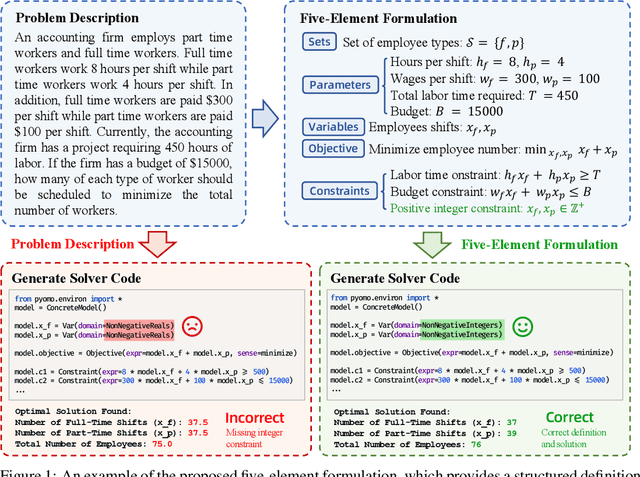
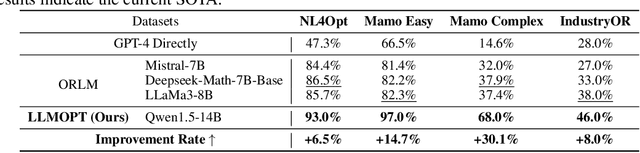
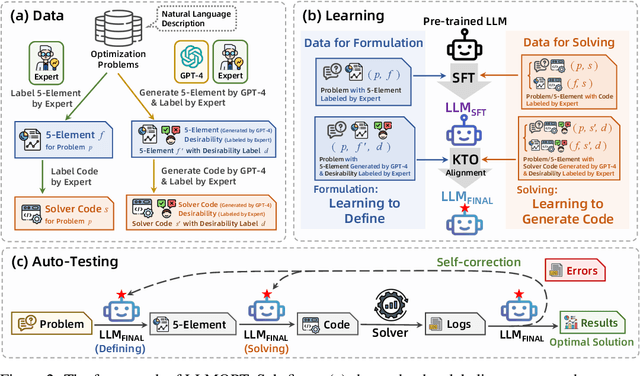
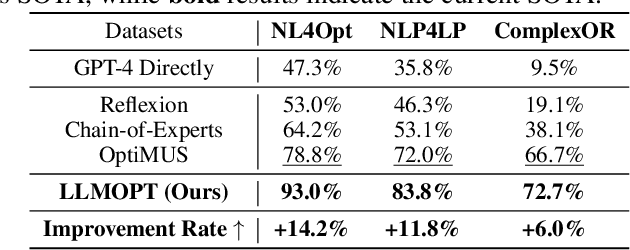
Optimization problems are prevalent across various scenarios. Formulating and then solving optimization problems described by natural language often requires highly specialized human expertise, which could block the widespread application of optimization-based decision making. To make problem formulating and solving automated, leveraging large language models (LLMs) has emerged as a potential way. However, this kind of way suffers from the issue of optimization generalization. Namely, the accuracy of most current LLM-based methods and the generality of optimization problem types that they can model are still limited. In this paper, we propose a unified learning-based framework called LLMOPT to boost optimization generalization. Starting from the natural language descriptions of optimization problems and a pre-trained LLM, LLMOPT constructs the introduced five-element formulation as a universal model for learning to define diverse optimization problem types. Then, LLMOPT employs the multi-instruction tuning to enhance both problem formalization and solver code generation accuracy and generality. After that, to prevent hallucinations in LLMs, such as sacrificing solving accuracy to avoid execution errors, model alignment and self-correction mechanism are adopted in LLMOPT. We evaluate the optimization generalization ability of LLMOPT and compared methods across six real-world datasets covering roughly 20 fields such as health, environment, energy and manufacturing, etc. Extensive experiment results show that LLMOPT is able to model various optimization problem types such as linear/nonlinear programming, mixed integer programming and combinatorial optimization, and achieves a notable 11.08% average solving accuracy improvement compared with the state-of-the-art methods. The code is available at https://github.com/caigaojiang/LLMOPT.
Preference Diffusion for Recommendation
Oct 17, 2024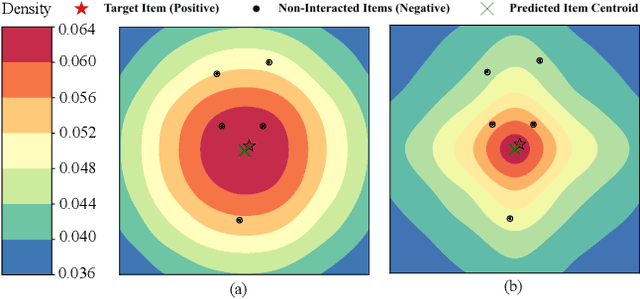
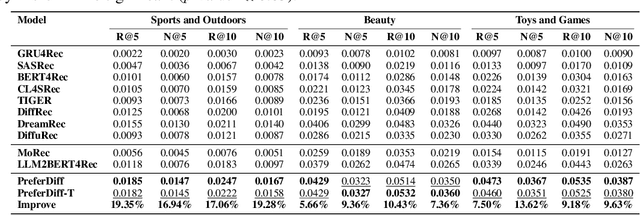

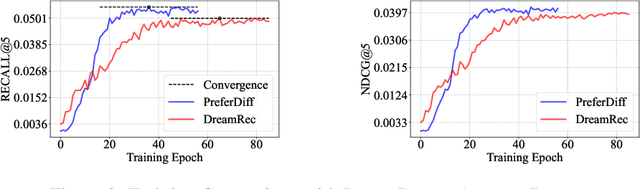
Recommender systems predict personalized item rankings based on user preference distributions derived from historical behavior data. Recently, diffusion models (DMs) have gained attention in recommendation for their ability to model complex distributions, yet current DM-based recommenders often rely on traditional objectives like mean squared error (MSE) or recommendation objectives, which are not optimized for personalized ranking tasks or fail to fully leverage DM's generative potential. To address this, we propose PreferDiff, a tailored optimization objective for DM-based recommenders. PreferDiff transforms BPR into a log-likelihood ranking objective and integrates multiple negative samples to better capture user preferences. Specifically, we employ variational inference to handle the intractability through minimizing the variational upper bound and replaces MSE with cosine error to improve alignment with recommendation tasks. Finally, we balance learning generation and preference to enhance the training stability of DMs. PreferDiff offers three key benefits: it is the first personalized ranking loss designed specifically for DM-based recommenders and it improves ranking and faster convergence by addressing hard negatives. We also prove that it is theoretically connected to Direct Preference Optimization which indicates that it has the potential to align user preferences in DM-based recommenders via generative modeling. Extensive experiments across three benchmarks validate its superior recommendation performance and commendable general sequential recommendation capabilities. Our codes are available at \url{https://github.com/lswhim/PreferDiff}.
It's Morphing Time: Unleashing the Potential of Multiple LLMs via Multi-objective Optimization
Jun 29, 2024

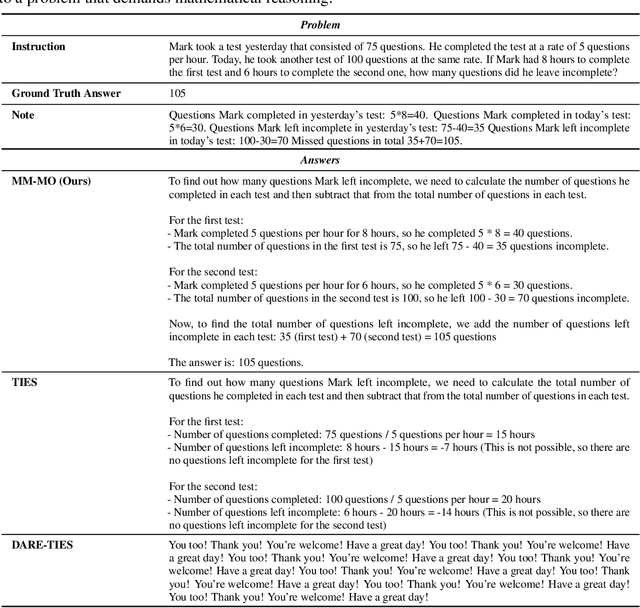

In this paper, we introduce a novel approach for large language model merging via black-box multi-objective optimization algorithms. The goal of model merging is to combine multiple models, each excelling in different tasks, into a single model that outperforms any of the individual source models. However, model merging faces two significant challenges: First, existing methods rely heavily on human intuition and customized strategies. Second, parameter conflicts often arise during merging, and while methods like DARE [1] can alleviate this issue, they tend to stochastically drop parameters, risking the loss of important delta parameters. To address these challenges, we propose the MM-MO method, which automates the search for optimal merging configurations using multi-objective optimization algorithms, eliminating the need for human intuition. During the configuration searching process, we use estimated performance across multiple diverse tasks as optimization objectives in order to alleviate the parameter conflicting between different source models without losing crucial delta parameters. We conducted comparative experiments with other mainstream model merging methods, demonstrating that our method consistently outperforms them. Moreover, our experiments reveal that even task types not explicitly targeted as optimization objectives show performance improvements, indicating that our method enhances the overall potential of the model rather than merely overfitting to specific task types. This approach provides a significant advancement in model merging techniques, offering a robust and plug-and-play solution for integrating diverse models into a unified, high-performing model.